



Paris Real Estate Market 2026: Prices, Trends and Outlook
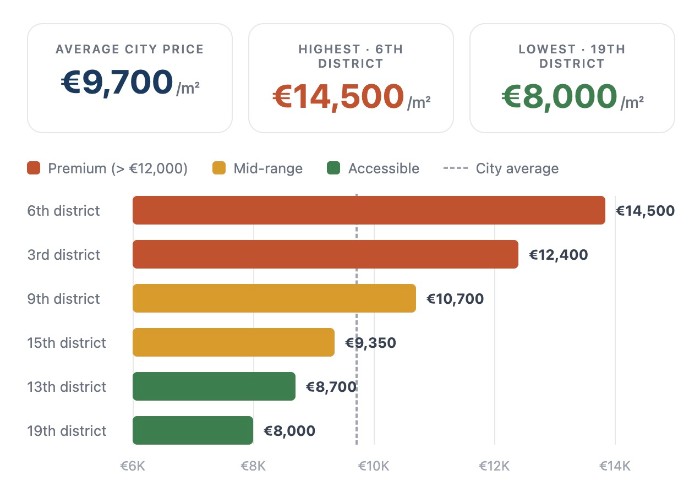
The capital and a global safe haven, Paris draws stronger international demand than any other French market, and 2026 is confirming its return to form. After the correction of 2023 to 2025, when prices fell roughly 8% to 10% across the city, the market is stabilising and edging up again, helped by easing borrowing costs and the comeback of overseas buyers. Across its twenty arrondissements, prices run from around €8,000 per square metre in the most accessible districts to nearly €15,000 in the most prestigious, a spread that rewards local knowledge.
In a market where the best properties trade off the public portals and competition is international, it pays to lean on a buyer’s agent who works the capital daily.
The parisian market in numbers: a cautious but real recovery
Paris led the national rebound in early 2025, with prices up 1.4% over the first half of the year against 1.1% for the wider region. Borrowing rates have settled slightly above 3%, around 3.35% on average and under 3% for the strongest profiles, which keeps purchasing power within reach for committed buyers. A few markers frame where the market stands:
- The 2023 to 2025 correction took roughly 8% to 10% off Paris prices, a phase now clearly behind the central arrondissements
- The prime segment has regained an arbitrage dynamic not seen since 2019, with international investors back in force
- Transaction times have normalised in fluid districts, around 48 days in the 9th for example, a sign of a working market
The underlying trend is stabilisation with measured increases rather than any renewed fall, and forecasts point to modest growth across 2026.
The arrondissements: a finely graded geography of prices
The 6th and the Left Bank: the prestige benchmark
The 6th holds its place as the most expensive arrondissement in Paris, averaging around €14,500 to €14,800 per square metre at the start of 2026, up 1.9% over the year. Saint-Germain-des-Prés, the Luxembourg Gardens and the Odéon set the tone for a market where every address has its own value and exceptional properties rarely surface online. Just across the river, the prime quadrilateral of the 7th near the Champ-de-Mars runs from €16,000 to €25,000 per square metre, climbing further for a clear Eiffel Tower outlook, the kind of rarefied stock covered in our look at the capital’s most prestigious addresses.
The 3rd and the Marais: the strongest momentum
The 3rd posted the best progression of any Paris arrondissement in 2026, up 2.1% over the year, with an average around €12,400 per square metre. It is at once a prestige and a scarcity market, with only about 312 sales a year. Prices span from roughly €9,000 in the Arts et Métiers sector to more than €20,000 for the finest hôtels particuliers of the Haut-Marais, where demand for character and rarity never really cools.
The 9th: central and resilient
One of the most dynamic markets on the Right Bank, the 9th weathered the downturn better than almost anywhere, slipping only 2% over five years against the citywide 8% to 10%. In spring 2026 it averages around €10,700 per square metre, with a median near €11,000, ranging from €7,900 in the northern sectors to over €14,000 around the Nouvelle Athènes. With roughly 542 sales a year and a median rent of €34 per square metre, it offers some of the best income potential in central Paris.
The 15th: family demand and space
The largest and most populous arrondissement, the 15th is the family heartland of the Left Bank. As of 1 March 2026 it averages around €9,400 per square metre across all property types, with apartments at €9,350 and new builds nearer €14,700. After a 4% dip over the year, the market is stabilising, with the sharpest demand for the scarce four-room-plus family apartments and a median rent of €37 per square metre that keeps investors interested.
The 13th and 19th: value and the Grand Paris Express effect
The east is where entry prices and upside meet. The 13th averages around €8,700 per square metre for apartments as of 1 March 2026, up 2.5% over the year, with the arrival of Line 15 South expected to lift values by 10% to 20% within walking distance of the new stations. The 19th remains the most accessible arrondissement at around €8,000 per square metre, one of the last places where first-time buyers can still purchase intra-muros, with the Grand Paris Express underpinning its revaluation. For houses and quieter streets just outside the boulevards, many buyers extend their search across the Greater Paris ring.
Rental yield: capital security over cash flow
Paris yields sit around 3% gross, below Lyon or Marseille, because the capital is bought above all for security and liquidity rather than income. That said, central demand is permanent and several factors shape the equation:
- Rent control (encadrement des loyers) caps rents across the city, which investors must factor into their projections
- Median rents run from around €34 per square metre in the 9th to €37 in the 15th, among the highest in the country
- Small and family units stay the most liquid, with studios selling in roughly two months and large apartments in three to four
For buyers who want to weigh these numbers properly before committing, it is worth seeing how we approach a purchase built around returns.
Energy rating: a growing price differentiator
Paris is dominated by Haussmannian buildings, many of them old and poorly insulated, which makes the energy rating an increasingly decisive lever. In 2026, an F or G-rated property can trade around 15% below an equivalent rated D, a gap of nearly €450 per square metre in some arrondissements. For buyers ready to renovate, it is a real negotiating opportunity; for sellers, a rising constraint on the asking price that is easy to overlook from a listing alone.
Outlook for 2026
Paris ranks firmly among the recovering markets. The return of international investors, the gradual easing of credit and the city’s renewed status as a patrimonial safe haven are driving the prime segment, while the Grand Paris Express is reshaping value across the east and the ring, with the strongest gains expected near the new stations. Expect contained growth overall, more pronounced in the districts in transformation and steadier in the already-valued central arrondissements. This rebound also explains why so many overseas buyers are returning, whether they are purchasing here as non-residents or specifically buying from the US.
Buying well in Paris with a property finder
The Paris market is one of the most opaque and competitive in the world. Within a single arrondissement, two neighbouring buildings can differ sharply in value depending on the co-ownership, the floor, the light, the view or the energy rating, the kind of detail that never shows on a portal. Homelike Home has guided demanding buyers across every premium district of the capital since 2003, with privileged access to off-market stock and full coordination through to signing. Whether you picture a Left Bank pied-à-terre or an apartment framing one of the city’s monuments, you can tell us what you are looking for.